



Indonesian Earthquake - Amateur Radio & Digital To The Rescue
- Details
- Hits: 668
A powerful magnitude 7.7 earthquake struck off Flores Island in Indonesia's East Nusa Tenggara (NTT) province on August 15, 2026, damaging nearly 12,000 homes, hundreds of schools and health facilities, blocking critical highway supply routes like the Trans Ende-Bajawa road via landslides, and disrupting communications throughout the region.
Indonesia's Emergency Management and Amateur Radio leadership's advanced preparation paid off. Repeaters with backup power systems and the IO-86 (Oscar 86) Satellite enhanced their HF capabilities, heavily leveraging digital modes.
Early in the incident Amateur Radio operators began relaying traffic using Winlink, JS8Call, and DDigi were used to send lengthier communications, short tactical messages, and formal ICS style messages, respectively.
Operators utilized the Winlink Network to send standard email - complete with text and small file attachments—entirely via radio waves. When local internet was down, stations connected via High Frequency (HF) radio to operational Winlink gateways hundreds of miles away in unaffected parts of Indonesia or neighboring countries, which then forwarded the messages to traditional internet email addresses.
JS8, a weak-signal digital mode, allowed operators to send live, keyboard-to-keyboard text messages under extremely poor radio conditions. Because JS8Call can decode signals that are completely buried in background noise, it enabled low-power stations with compromised or temporary antennas to successfully transmit critical text updates.
FlDigi was deployed to send structured, error-free text forms. By pairing FLdigi with Flmsg, operators used standardized emergency templates (such as ICS forms) to ensure that medical needs, logistics requests, and structural damage reports were sent accurately without typing errors.
Indonesian operators went one step further proving this isn't you grandfather's radio hobby anymore. The IO-86 amateur radio satellite (officially known as LAPAN-A2 or LAPAN-ORARI) was activated by Indonesia’s national amateur radio society, ORARI, as a critical spaceborne communications bridge during the August 2026 earthquake response.
Because the earthquake disrupted ground-based towers and isolated remote mountain hamlets, operators used the satellite to relay data directly over the disaster zones. The satellite was utilized in two primary ways, tactical voice via the satelite's cross-band repeater and the onboard APRS repeater for short text messaging and position reporting.
Standard line-of-sight VHF/UHF Handheld Transceivers cannot communicate across mountains. However, when IO-86 passed overhead, its FM cross-band transponder (uplink: 145.880 MHz / downlink: 435.880 MHz) acted as a flying radio repeater. Low power (5W) radios with Arrow or other Yagi antennas allowed scheduled tactical communications.
IO-86 carries an Automatic Packet Reporting System (APRS) digipeater operating under the tactical callsign YB0X-1. This payload acted as a digital relay in space, not just allowing tactical text traffic, but also update tactical team locations.
Unlike most polar-orbiting amateur satellites that only pass over a specific region twice a day, IO-86 flies in a specialized low-inclination equatorial orbit. This allowed the satellite to pass over the Indonesian archipelago roughly 14 times a day. This high-frequency pass schedule provided disaster response teams with predictable, recurring windows of satellite coverage every few hours to send and receive life-saving reports when traditional networks were completely dead.
Colombian Earthquake 2026
- Details
- Hits: 919
Colombia’s communications infrastructure experienced significant after the magnitude 7.4 earthquake on August 10, 2026. Effects were concentrated in western departments—especially Chocó, Valle del Cauca, Risaralda, Quindío, and Caldas—with intermittent service nationwide initially due to congestion.
Only a few days later things are returning to normal as far as infrastructure is concerned. The power grid is coming back online and communications systems are mostly restored.
Main Disruptions
Network congestion: A sudden surge of calls and data traffic from people checking on family/friends and contacting emergency services overloaded the communications network. Communications networks are designed to operate on the principle that only a small percentage of people will actually be using their phone at any given moment, but a wide-ranging incident creates a rush on the system which will usually overload it. BTW, Texting uses less system resources, and can also be queued for later delivery during congestion, making it a good way to communicate during an emergency.
Power outages: Interruptions to electricity (affecting ~18% of national demand initially, with rapid recovery to ~99%) disabled or limited cell towers and equipment once backup batteries/generators ran low.
Physical/infrastructure damage: Some damage to fiber-optic cables (from ground shifts or collapses), towers, and related equipment; possible antenna misalignment. Damage was more limited than the congestion and power issues in many areas.
Access and logistics challenges: Damaged roads, landslides, and ongoing aftershocks hindered repairs, particularly in remote or hard-hit zones like parts of Chocó. Internet connectivity disruptions were confirmed by monitors (e.g., NetBlocks, Cloudflare data showing traffic drops).
Amateur Radio Response
Amateur radio provided critical backup emergency communications support during the response, particularly where commercial cellular, internet, and power systems were disrupted.
The Liga Colombiana de Radioaficionados (LCRA / LCR) activated its emergency network. Members deployed alongside the Colombian Red Cross to deliver communications support. Faber Mosquera (HK6F), the LCRA emergency coordinator, coordinated with the National Disaster Risk Management System for damage assessments in the hardest-hit areas; later joining the urban search-and-rescue team (Colombian Red Cross, Quindío Chapter) as it deployed to Cali.
Asociación de Radioaficionados del Eje Cafetero (ASOREC, Colombia's ARRL counterpart) made its infrastructure (including repeater stations) available to support communications in Pereira, one of the most severely damaged cities. Volunteers under president Nahir Rios (HK6JSP) had water, food, and backup power sufficient for at least 72 hours.
Liga Radio Manizales (LRM, a regional radio club) linked its Echolink system to the national emergency frequency, connecting with ASOREC and extending reach.
Impact of Amateur Radio
Amateur radio filled gaps created by widespread power outages, cellular congestion, and damaged telecom infrastructure—especially in the early hours and in areas with limited commercial connectivity. It supported coordination between responders (including Red Cross search-and-rescue teams), facilitated damage assessments, and helped maintain links in affected cities such as Pereira, Manizales, and Cali.
This role was typical of amateur radio’s function in major disasters: providing independent, battery- or generator-powered HF/VHF links that do not rely on the public telephone or internet networks. While commercial services recovered progressively over the following days, amateur radio networks offered resilient backup during the critical initial response phase.
Press releases from IARU and ARRL emphasize activation and coordination rather than specific quantified outcomes (e.g., number of messages passed or lives directly saved via radio), which is common early in the response. Hopefully we'll get additional information as time goes on.
Initial lessons learned
Our Colombian counterparts were well prepared for a 72 hour deployment, Conventional deployment theory is to have Rapid Response Teams (RRTs) which deploy for the first 24 hours, who are often 72 hour repsonders as well. In other cases it is expected the RRT would be releaved by a 72 hour team, which would then be followed by either additional 72 hour rotations or long term deployment teams.
They were equipped to function for 72 hours without drawing on any other infrastructure; they provided their own food, water, equipment, and power. This is important because resources will be strained during the initial response, and resources should be focused on those directly adversely affected by the disaster.
They had a plan, which included operating frequencies, linked repeaters, and even the ability to interface to Echolink to provide broader communications once linked repeaters were communicating into an area where internet and power was available.
Their involvement wasn't just holding a microphone at a shelter of Emergency Operations Center (EOC), but included deployment with other groups, like damage assessment teams.
Field Deployment Of Antennas
- Details
- Hits: 1835
Field Day provides great practice setting up antennas "on the fly" somewhere other than on home turf. However, it is a planned activity, and the event venue is often the same one, two, or few places. As a result, setting up becomes almost a reflex action in some cases. Good practice, and well worth the effort, but we often don't need to consider things like we did the first time or two we setup somewhere.
Things we have to consider when setting up at an unknown location include site selection and safety, the most efficient means of getting up and operating, propagation and proper antenna orientation, optimizing the installation, and the need to avoid some pitfalls related to setting up "on the fly".
When arriving at a new location we need to consider takeoff angles for HF and line-of-site for VHF/UHF,
Operation Talladega Signal
- Details
- Hits: 0
As many of you may know, we have an upcoming exercise, where we'll put various amateur radio skills together to test our ability to assist in emergency response. Operation Talladega Signal will take place on March 28, 2026 at the Big Oak Hunt Camp, Talladega National Forest, 11:00AM Eastern, 10:00AM Central. This will be a great opportunity for all of us to practice our existing skills and learn new ones, so I hope you'll attend.
At the heart of the exercise will be to cooperatively use Radio Direction Finding (RDF) skills to locate a lost hiker who will be calling for help on an FRS radio. FRS frequencies are close enough to our 70cm band that our equipment should work fine, as almost all 70cm radios will tune out-of-band for receive.
P.A.C.E. and EMCOMM
- Details
- Hits: 2004
The military, various government entities, and some NGOs, plan for emergencies by implementing a multi-layered plan. Essentially, four "independent" levels, each one more reliable and less reliant on infrastructure than the one before it. As you might imagine, each letter represents one of the levels: P(rimary), A(lternate), C(ontingency), and E(mergency). I suspect you can guess which layer we fall into!
For PACE to function all players must roll through the levels in order, from P to A, A to C, and C to E. As we often say, Amateur Radio: When all else fails!
While each layer is to be independent of the resources of the preceding one, it is not always the case. Obviously, the more self-contained each system is, the more likely it is to function despite other failures.
HOAs, Amateur Radio, & EMCOMM
- Details
- Hits: 2083
Amateur Radio Operators and HOAs go together like oil and vinegar in most cases. Rules regarding antennas or "other structures" on a property bound by HOA rules often makes installation of HF antennas impossible, and even makes VHF/UHF installations challenging and less-than-optimal.
The FCC has addressed local ordinances with PRB-1, which legally inhibits local governments from imposing unreasonable limitations on radio operators. Our ability to provide emergency communications support is at the core of the argument made for PRB-1 freedoms. Sadly, PRB-1 does not impact HOAs because the HOA rules are imposed by private contract, not legal ordinances.
NVIS Antenna Configurations
- Details
- Hits: 4854
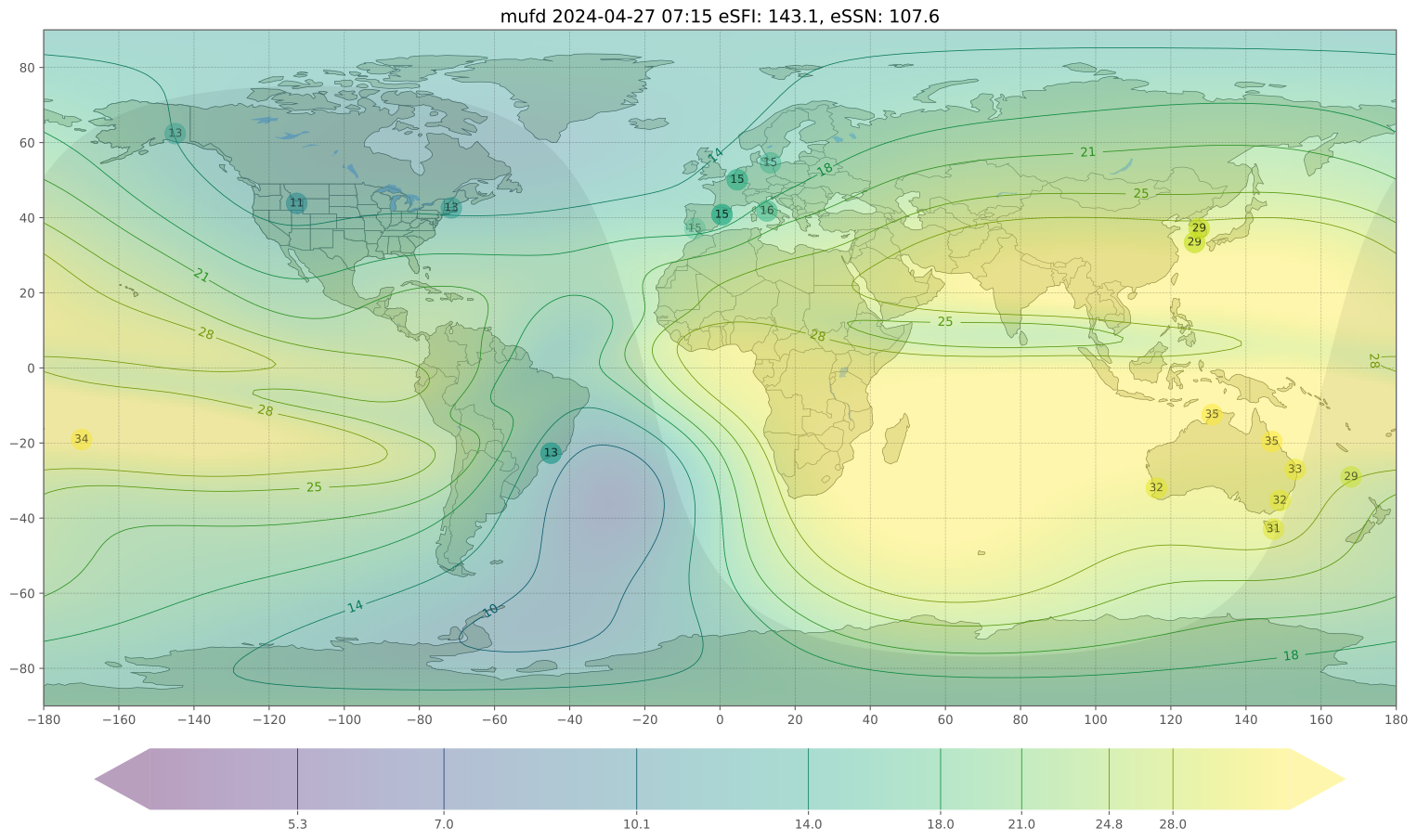
NVIS (Near Incidence Vertical Skywave) is best accomplished transmitting in the most common NVIS bands (80, 60, ad 20m) with a very high angle of incidence, the radio waves going almost straight up. This is the exact opposite of what we are doing when we're "DXing" (distant communications); as a result, almost all the logic we apply to setting up antennas is turned on its head. We must utilized antennas in ways we typically would avoid, and we'll cover the different ways here. The key is to remember we are attempting to direct radio waves upwards, rather than towards the horizon.
Dipole Antennas
These are the most common antennas in amateur radio. They are easy to make and work well. For DX, all you need to do is get them as high off the ground as you can get so the bulk of the radio signals are radiated towards the horizon.
QRP, NVIS, and 60 meters in EMCOMM
- Details
- Hits: 3471
Low Power (QRP), Near Incidence Vertical Skywave (NVIS), and the 60 meter band looks more and more to be intended for use in Emergency Communications (EMCOMM). I've touched on all of this over the last few presentations, so all I'm really doing here is putting it together.
The recent changes to the 60 meter band embrace the use of QRP on that band. What was the third channelized frequency in the 60 meter band has been eliminated, the frequency spectrum in consumed, and the adjacent portions of the band between the 2nd and 4th channels is now VFO tunable - with the caveat that operation must be QRP (9.15W ERP). The remaining channelized frequencies may still operate at the previous 100W (ERP) level.
The New 60 Meter Band
- Details
- Hits: 3786
Recent NVIS tests we conducted showed, at least for early daytime hours, 40 meters worked best for NVIS, although both 10 and 20 meters did perform, just not as well as 40 meters. As one might expect, 80 meters did not work well in daytime for NVIS.
Some of us discussed 60 meters, the channelized band, as a possible NVIS candidate. An indication it might perform well is the fact the Federal Government uses it as part of their emergency communications system and SHARES, a public/private emergency communications network.
During those discussions we considered executing a NVIS exercise that included 60 meters. Coincidentally, the FCC has made changes to the 60 meter band, eliminating one of the channels and replacing it
Antenna Polarization
- Details
- Hits: 4558
Our recent NVIS (Near Incidence Vertical Skywave) experiments brought to light a discussion of antenna polarization. Does it matter? Does it impact NVIS? Absolutely and absolutely.
First, lets talk about polarization on VHF. We all generally run vertical antennas when running VHF-FM. It works well when reaching out to repeaters or attempting point-to-point simplex communications. However, if two operators are attempting to communicate VHF-FM and one is horizontal and one is vertical, they will have issues. The E-fields are oriented perpendicular ("cross-ways", so to speak), and the loss of 10db-20db, signal degradation to 1/10th to 1/100th, is the result. It's just the nature of how radio signals are picked up by the antenna. In this case, compatible orientation is vital.
Page 1 of 8